|
|
|
|
|
|||
| June 2016 -- Learning Sites president, Donald H. Sanders, will be speaking at Hevreh of Southern Berkshire (Great Barrington MA) on the subject: The Jewish People versus the Assyrians Kings: how virtual reality helps us understand and preserve what has now been lost. The talk will touch on several projects underway at Learning Sites covering such topics as corroboration among biblical passages and ancient Assyrian texts, how virtual heritage provides new insight into the past, and how 19th-c. excavations in Mesopotamia profoundly changed our perceptions of biblical writings.
For further information about the time and place of this event, see the Jewish Federation of the Berkshires Website. |
|||
| January 2016 -- This is an important event for anyone concerned about the loss of cultural heritage due to wanton destruction: The Future of the Past:Digitizing Cultural Property in an Era of Destruction. A symposium associated with the exhibition The Missing: Rebuilding the Past will be shown at the Anya and Andrew Shiva Gallery at the John Jay College of Criminal Justice, City University of New York. The symposium will be held on Friday, January 22, 2016, at 3-5 pm and will include a demonstration of the immersive virtual reality project, Nimrud Rising on Friday, January 22, from 1-3 pm, and Saturday, January 23, from 1-5 pm at the Shiva Gallery, John Jay College, with entrance at 860 11th Ave., New York City between 58-59th Streets.
Learning Sites will be demonstrating (using an OculusRift VR headset) its immersive virtual reality re-creation of the recently dynamited Northwest Palace at Nimrud. Nimrud Rising is a joint project with the Antiquities Coalition. You can learn more about the exhibit, the symposium, and our VR demo on the HyperAllergic review and in the story prepared by American Television News and on various blogs, e.g., by ASOR and by Bonnie J. Gordon. |
|||
|
|||
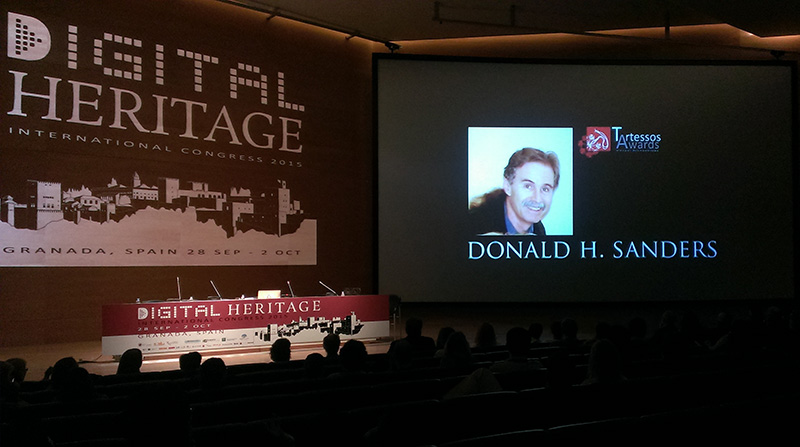
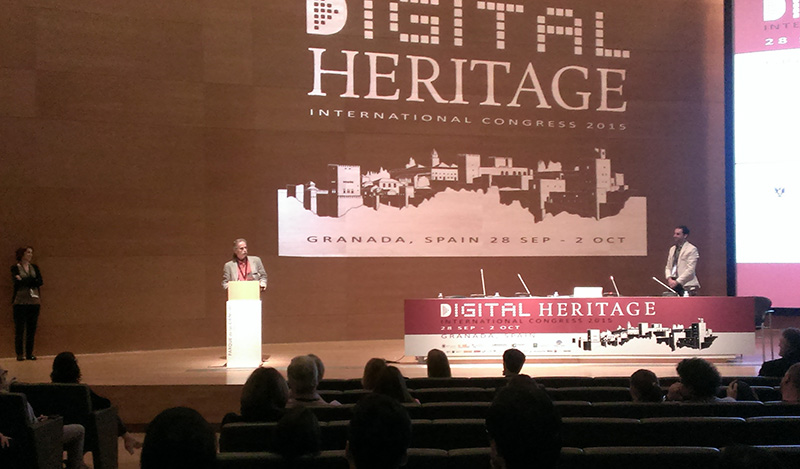
| October 2015 -- Donald H. Sanders, president of Learning Sites, was awarded the prestigious Tartessos Prize in virtual archaeology by the Spanish Society of Virtual Archaeology, at the International Congress on Digital Heritage, Granada, Spain: | |||
|
|||
| September 2015 -- Donald H. Sanders, president of Learning Sites, was a featured speaker at the 16th annual City of David Archaeological Conference, Jerusalem. The conference focused both on methods to combat purposeful destruction of cultural heritage sites and on recent discoveries in the City of David excavations. Sanders spoke on the value of 3D computer models and other digital recording and documentation systems as ways to ensure that destroyed archaeological treasures can live on, be studied, and serve as lessons for future generations. Examples from the links between Assyrian sites and inscriptions of the 8th-7th centuries BCE and events along the eastern Mediterranean coast, based on Learning Sites interactive virtual worlds of Nimrud and Nineveh, illustrated that value.
Reports about the conference can be read online from the Israel National News service, TheMediaOnline and the Israel Hayom and Jerusalem Post newspapers. Sanders conference presentation has been published in the conference proceedings. |
|||
| August 2015 -- Learning Sites has been awarded an NSF SBIR Phase II TECP (Technology Enhancement for Commercial Partnerships) grant to expand the functionality of our CUNATTM cuneiform translator smartphone app in order to solve the problem of finding and identifying the 2D characters, and then translating 2D texts, especially those written across curved or irregular surfaces for which traditional optical character recognition systems would be ineffective.
More specifically, our partner, the Department of Egyptian Art at the Metropolitan Museum of Art (MMA), has an overwhelming number of ancient labels in the form of short hieratic script texts found handwritten on the shoulders of pottery vessels that come from the excavations at Malqata (one of the few ancient Egyptian royal cities known). The nearly 1400 handwritten hieratic dockets found on large storage jars and amphoras identify their contents and the place delivering the provisions. A significant urban site, Malqata was established by the pharaoh Amenhotep III in the 30th year of his reign (about 1360 BCE) when he celebrated his first heb-sed, a royal jubilee intended in part to rejuvenate the king. Continuing excavations by the MMA, which have the potential of uncovering more texts, combined with the limited personnel and time available by members of the field team and MMA staff to translate all of the labels, mean that these crucial written resources cannot be efficiently analyzed and published. Staff time and energy would be best spent studying the contents of the texts rather than on the tedious and labor-intensive job of translation. The results of the collaboration will provide new means to help translate, catalogue, and sort hieratic texts and speed these activities at ongoing excavations, make scholarly research much more effective, and provide new educational materials for fieldwork, thousands of museums, related collections, and schools worldwide. The short texts provide valuable information about the flow of goods to a pharaoh's festival, the number of scribes who worked on the texts, the types of goods coming to the celebration, and how such items were tracked during these special events--all of which would be new information and information that would otherwise take curators years to collocate and study. The hieratic module to the existing CUNAT app will allow new questions to be asked about the Egyptian texts (such as about their paleography--identifying scribal hands--and the economics of goods movement) that cannot now be posited based on traditional translation and publication methods. |
|||
| June 2015 -- A semester-long partnership between Learning Sites and students in the computer science department at the University of Illinois Champaign-Urbana has created a stunning repurposing of the throne room of the Learning Sites Northwest Palace, Nimrud, 3D model for the OculusRift VR headset. The immersive experience of the throne room was enhanced by adding interactivity to test new types of learning environments. Objects and features throughout the world had links, activated by gaze, that triggered audio files describing the objects or features, and also brought up photographs and drawings to supplement the user's understanding of the linked objects. Other effects like real-time lighting and animated characters were also included.
Both the course description and the resulting VR museum explanation with sample images are online. |
|||
| March-April 2015 -- The Berkshire Eagle newspaper (online and as the cover story to its Sunday March 29, 2015 paper) published an article on Learning Sites' virtual reality reconstructions of the citadel at Nimrud and the destruction at the site by ISIS/Da'esh. Could our digital models be the only remaining reminders of the greatness of ancient Assyrian culture to educate future generations? The article includes new renders from our model of the Northwest Palace, as well a the discussion of the importance of digital surrogates of the world's treasures.
See also the ISIS/Da'esh online video showing their destruction of the Northwest Palace, Nimrud (but be advised this is an awful heart-wrenching display: http://youtu.be/PT85j1xA3d8) Further video has now appeared that, if genuine, seems to show explosions utterly reducing the entire Northwest Palace to rubble, leaving our 3D computer model and expanding virtual world as the only surviving visualization of what has been considered one of the greatest palaces of all time: http://news.nationalgeographic.com/2015/04/150414-why-islamic-state-destroyed-assyrian-palace-nimrud-iraq-video-isis-isil-archaeology/ |
|||
| March 2015 -- Cuarta Milenio Spanish TV has aired a special program on the destruction of archaeological sites. Learning Sites animated flythrough of its 3D model of the Northwest Palace of King Ashur-nasir-pal II, Nimrud (Assyria, present-day Iraq), is featured in the program as an example of the contrast between what has now been lost and the magnificence of what once stood as the height of culture nearly 3000 years ago. Our animation can be seen after about the first 30minutes of the program (note that some footage of the program may be disturbing for the depiction of wanton destruction): http://www.mitele.es/programas-tv/cuarto-milenio/temporada-10/programa-402/
See also the ISIS/Da'esh online video showing their destruction of the Northwest Palace, Nimrud (but be advised this is an awful heart-wrenching display: http://youtu.be/PT85j1xA3d8) |
|||
|
|||
| September 2014 -- Learning Sites animated flythrough of its 3D model of the Northwest Palace of King Ashur-nasir-pal II, Nimrud (Assyria, present-day Iraq), for the Metropolitan Museum of Art's (NYC) exhibition entitled From Assyria to Iberia: Crossing Continents at the Dawn of the Classical Age, has been installed and will be open to the public beginning Sept. 22. For more information on the show, see: http://www.metmuseum.org/exhibitions/listings/2014/assyria-to-iberia). Our animation is being projected large on a wall near the beginning of the show. Take and look and let us know what you think ! | |||
| May 2014 -- Learning Sites' NSF-funded CUNAT app project (see below August 2013) has created a video of its progress to date, a poster to explain the need for the approach, and set up a Website for discussion about future features, applications, and innovations. See www.translation-engine.com for further details. | |||
| April 2014 -- Learning Sites signed a contract with the Metropolitan Museum of Art, NYC, to provide an animated flythrough of its 3D model of the Northwest Palace of King Ashur-nasir-pal II, Nimrud (Assyria, present-day Iraq), for the museum's upcoming exhibition entitled From Assyria to Iberia: Crossing Continents at the Dawn of the Classical Age, set to open September 22nd. The animation will play life-size to give visitors an immersive sense of what it was like to experience the magnificent palace. | |||
|
|||
October 4, 2013 -- Learning Sites has just signed a contract for a 5-year project to model the entire site of Gebel Barkal, Sudan, a premier Nubian ritual, political, and burial site. This project continues our long association with Timothy Kendall and will be funded as part of the Qatar-Sudan Archaeological Project. Among the innovations that this project will develop are:
|
|||
| August 29, 2013 -- Learning Sites has just been awarded a prestigious NSF SBIR Phase II grant for a project entitled Extracting Valuable Information Automatically from Objects with Surface Impressions via Photographs and Interactive Digital Surrogates.
This Small Business Innovation Research Phase II project will complete toward commercialization the proof-of-concept Cuneiform Automated Translator (CUNAT) system developed in Phase I, which included advances in photo-modeling, surface segmentation, geometric character recognition, interactive 3D model viewing and manipulation, ancient language translation, mobile-device application development, and rules-based engine logic. CUNAT demonstrated that the proposed approach could have significant impact on a discipline focused on slower manual methods. This SBIR Phase II project will expand the system to address critical needs across the field of archaeology and to produce a commercially viable product suite with applications to problems in museum exhibition, forensics, paleontology, numismatics, digital art history, and beyond. Ancient Mesopotamian legal treatises, Egyptian medical records, and Roman political accounts--telling us exactly what happened in the words of the very people whose actions formed our history--languish untranslated, because there are too many of them, translation takes too long, and there are too few linguistic experts. “Cuneiform text genres include everything...from mathematical and grammatical exercises, beer recipes, international treaties, musical scores, legal codes, religious rituals, sales receipts, and astronomical tables....[M]useums...have acquired approximately 400,000 tablets, with thousands being unearthed every year.... [S]cholars continue to make unique and valuable contributions to the study of history, law, religion, linguistics, mathematics, and science” (Digital Hammurabi Project). CUNAT will allow anyone to create 3D models of such artifacts and automatically extract meaning from their impressions more effectively and quickly than existing tools. Imagine a high-school student entering an art museum and seeing an object with triangular-shaped surface incisions. The label reads: “cuneiform tablet, 864BCE, Nimrud.” Curious, the student aims a smartphone camera at the object and clicks. The images are uploaded into the CUNAT app, which generates an interactive 3D model and an English translation of the inscription. The student may be the first person to have read the text and discover previously unknown astronomical knowledge detailed by the ancient scribe. CUNAT gives this research power and excitement of discovery to everyone, every institution, anywhere, anytime, because neither expensive special equipment nor complex calibration or lighting are necessary to produce results with unprecedented efficiency and accuracy. |
|||
| January 30, 2013 (March 20, 2013; and May 23, 2013)-- Continuing a news item from late last year, Time Magazine online has picked up the story of Learning Sites photomodeling project with the Semitic Museum at Harvard, as has Popular Mechanics, and Dezeen. | |||
|
|||
| December 4, 2012 -- Learning Sites innovative photomodeling techniques are being applied by Harvard University's Semitic Museum to study broken sculptures from the ancient site of Nuzi (in modern-day Iraq). The Harvard Gazette has just published an article detailing the collaboration. Our new techniques allow museums to obtain high-resolution 3D computer models without the need for expensive laser scanners, without elaborate lighting, and without having to remove the objects from the museum or even its galleries. When combined with CNC printing, the process opens whole new avenues of research and museum display. Additional information can be found on the Semitic Museum Website. On Dec. 10, the story was picked up and expanded by Wired.com and on Dec. 11 by the Art World Daily (and see Jan. 30, 2013, above) Or you can simply type in "Semitic Museum" and 3D into your favorite search engine and read about the story in dozens of online sources all over the world or read about it right here !!
How can we help your museum ? |
|||
| November 8, 2012 -- Donald H. Sanders, president of Learning Sites, will be giving the AIA lecture at Princeton University on this date. His topic will be: An Assyrian Palace: How Virtual Reality is Changing How We Understand the Past. The lecture will take place at 5pm at 106 McCormick Hall, Princeton University. | |||
| May 28, 2012 -- Learning Sites has just been awarded a National Science Foundation (NSF) Small Business Innovation Research (SBIR) Phase I grant (#IIP-1215308) to create new software for automatically creating textured, 3D digital models of the impressions on cuneiform tablets and other objects from multiple digital photographs and for automatically performing geometric character recognition on the impressions in order to derive meaning. The proposed system, which will be more accurate, faster, and a more effective detective tool than any current alternative, comprises: (1) reconstructing detailed models of cuneiform tablets from multiple photographs; (2) isolating individual cuneiform strokes and distinguishing meaningful characters from background cracks; (3) classifying, against lexicons, the characters based on geometric characteristics; and (4) performing preliminary automatic word identification leading to translation of the texts. The grant is entitled Extracting Valuable Information Automatically from Objects with Surface Impressions via Photographs and Interactive Digital Surrogates and will be performed in partnership with Brown University. | |||
|
|||
| June 17, 2011 -- We are pleased to announce that a License Agreement has been signed between Learning Sites and MellaniuM (www.mellanium.co.uk) with the purpose of importing one of Learning Sites virtual worlds into the web.alive / Unreal platform for eventual immersive global collaborations. The first Learning Sites virtual world to make the transition will be the Vari House (a 4th c. BCE Hellenistic beekeeper's house in Attica, Greece). The Vari House was excavated in the 1960s, and the 3D computer models developed by Learning Sites became a pioneering virtual world for interactive education in the late-1990s. It seemed appropriate that this well-known package become the first test case of the new partnership. Learning Sites has been an international leader in innovative digitally reconstructed ancient worlds for interactive education, research, museum display, broadcast, tourism, and publication.
With a feature set designed originally for the enterprise, web.alive is a web browser plug-in that integrates with an existing network, security, and business applications to enhance communications, collaboration, and employee or consumer engagement. In this way, web.alive minimizes operational overhead, dramatically increases accessibility to users, and delivers face-to-face interaction at the low cost of Web collaboration. Avaya web.alive represents the future of communications and offers the best of publicly and privately accessible immersive Web conferencing.
MellaniuM has leveraged this platform to produce unique and innovative environments scaled to up to 10km square containing very high-polygon models. These environments can be developed either from existing 3D mesh models compiled from 3D modeling packages or from geo-referenced terrain maps using the latest UAV scanning techniques. For example, it is entirely possible to create accurately scaled simulations of long-gone masterpieces of the Industrial Revolution or entire archaeological sites, as we hope this partnership will demonstrate.
Keep watching our two Websites for updates about and invitations for joining in the Vari web.alive experience.
|
|||
| January 26, 2011 -- Learning Sites has installed an animated flythrough and a virtual reality module in the galleries of the Williams College Museum of Art (Williamstown, Massachusetts); each installation uses the latest Learning Sites 3D computer model of the Northwest Palace of King Ashur-nasir-pal II at Nimrud, Assyria (present-day Iraq). The installations are for a new show called A Collection of Histories. The show uses the Williams College Museum of Art’s two Assyrian reliefs as case studies for how works of art accumulate collections of histories over time. The reliefs, the first to come to America from ancient Assyria, arrived on the Williams College campus in 1851. By unfolding the layers of history, we can examine the significance of context in shaping meaning and confront an essential question: Who owns the past? This exhibition is part of the museum’s innovative reinstallation project entitled Reflections on a Museum. All of the exhibitions in this project take “the museum” as their subject, exploring everything from the role of a curator to what makes something a work of art. The show will run for two years beginning on February 3, 2011.
The virtual reality module is the first Learning Sites' world to include a virtual tourguide who, upon request, will lead viewers to points of interest in and around the Palace. En route, the guide explains what is passing by. Once at a destination, users can access context-specific descriptions, photos, drawings, and 3D models. Read the Williams College press release at: http://wcma.williams.edu/press/collection_of_historie/ |
|||
|
|||
| June 17, 2010 -- ARQUEOLÓGICA 2.0 will analyze both the present and future of digital reconstruction and computer-aided rendering techniques as applied to archaeological heritage and culture. The conference's goal is to offer an updated overview about archaeology in the 21st century, with special emphasis on: research and development in virtual archaeology, planned projects, new rendering techniques, development of new methodologies, and the cooperation of professionals from different fields, in order to encourage an exchange of both knowledge and experience.
Donald Sanders will speak about "Enabling Archaeological Hypothesis Testing in Real Time using the REVEAL Documentation and Display System." |
|||
| April 22, 2010 -- The Archaeology and Architectural Committees of the National Arts Club present Dr. Donald H. Sanders, President of Learning Sites, Inc. He will discuss a few of the difficult archaeological sites his company has re-created such as the Northwest Palace of Ashur-nasir-pal II at Nimrud in ancient Assyria, the Old Athena Temple from the Acropolis, and the Actium victory monument at Nikopolis erected by Octavian prior to his being granted the supreme title Augustus.
Understanding history isn't simple; we weren't there. Additionally, history didn't occur in two dimensions; so why study it only through photographs and drawings? Virtual Heritage, pioneered some fifteen years back by archaeologist-architect Donald Sanders, amongst other professionals, developed as an alternative by building computer-generated, interactive, three-dimensional models of ancient settings, events, and cultures. Earlier, illustrated volumes and instructural audiovisual materials educated. Twenty-first century's sophisticated digital techniques including virtual reality offer entertaining worlds that allow us to experience visually a richly dynamic world. Thus, a reconstructed past emerges in the present, offering fuller insight into its unique period, guiding us to live better in our own times. For further information, including address and directions, see: http://www.nationalartsclub.org/ |
|||
|
|||
| August 31, 2009 -- Learning Sites Inc. has been selected for the 2009 Best of Business Award in the Computer Graphics category by the Small Business Commerce Association (SBCA).
The SBCA 2009 Award Program recognizes the top 5% of small businesses throughout the country. Using consumer feedback, the SBCA identifies companies that we believe have demonstrated what makes small businesses a vital part of the American economy. The selection committee chooses the award winners from nominees based off information taken from monthly surveys administered by the SBCA, a review of consumer rankings, and other consumer reports. Award winners are a valuable asset to their community and exemplify what makes small businesses great. Small Business Commerce Association (SBCA) is a San Francisco based organization. The SBCA is a private sector entity that aims to provide tactical guidance with many day to day issues that small business owners face. In addition to our main goal of providing a central repository of small business operational advice; we use consumer feedback to identify companies that exemplify what makes small business a vital part of the American economy. Small Business Commerce Association: http://www.SBCAAwards.org |
|||
| March 3, 2009 -- The American Turkish Society presents a film screening and discussion at Temple Emanu-El, New York City (beginning at 6pm), of Queen of the Mountain and Theresa Goell's work in Turkey. Martha Goell Lubell (producer and director of the film) and Donald H. Sanders, President, Learning Sites, Inc. will speak and be available for questions. Space is limited and reservations are required. Download or open the .pdf file for additonal contact and sign-up information (Adobe Acrobat Reader required to open the .pdf file). | |||
|
|||
| October 18, 2006 -- The Hood Museum of Art at Dartmouth College (Hanover, NH) has opened two new installations created by Learning Sites expressly for their latest exhibition and symposium entitled From Discovery to Dartmouth: The Assyrian Reliefs at the Hood Museum of Art, 1856-2006. The museum's collection includes six large reliefs from the Northwest Palace, Nimrud (ancient Assyria, now Iraq). Learning Sites developed a 6-minute animated flythrough of the Palace featuring the Hood's reliefs in their original locations, as well as a virtual reality package that allows users to explore the Palace, view linked photographs of the excavation, and read background text about the site and the sculptures. Both installations were created specifically to place the Hood's reliefs into simulations of their original contexts in order to elucidate their functions within the Palace's overall sculptural program.
In conjunction with the exhibit, a 2-day symposium (November 3-4, 2006) sponsored by the museum is bringing in noted scholars in Assyrian art and archaeology to discuss the significance of the Palace and its decoration. The animation has been installed in the gallery next to the reliefs where it continues to enthrall visitors. |
|||
| July 30, 2006 -- The local National Public Radio (NPR) affiliate in Cincinnati (WVXU, 91.7FM) will broadcast a news story about Virtual Heritage on Sunday, July 30, 2006, in which the work of Learning Sites will be discussed and during which its president, Donald H. Sanders, will be interviewed. The full program will then be available for repeat listening on WVXU Website starting on August 1, 2006 (go to the Website, click on Programs, then on Cincinnati Edition, then scroll down and click on Cincinnati Edition Archive, and then click on Sunday July 30, 2006; then scroll down and click on Virtual Heritage). | |||
| March 15, 2006 -- The competitive results are now available for The Archaeology Channel International Film and Video Festival, held last week at Eugene's McDonald Theatre, Eugene, Oregon (USA). The Festival, which took place March 7-11, featured many of the world's best films and videos on archaeology and indigenous peoples, as well as an in-person presentation (“Chaco Canyon: America's Stonehenge”) by leading author and archaeologist Dr. Brian Fagan. Producers and distributors from 15 countries worldwide submitted 56 film entries to the Festival, of which 17 films from 7 countries were screened in front of the McDonald Theatre audience. Awards listed below are in three categories: Best Film (by jury), Best Use of Animation (by jury), and Audience Favorite, as well as a Special Mention Award designated by the Festival jury.
"Our impression that this was our best line-up of films yet for the Festival was confirmed by the audience ballot results and the jury's comments," said Richard Pettigrew, President and Executive Director of nonprofit Archaeological Legacy Institute (ALI), which organized the Festival. “We made a special effort to solicit the best films from around the world and that strategy paid off in terms of the quality of the content viewed by our Festival audience.” Both top awards (Best Film by Jury and the Audience Favorite Award) went to the American film Queen of the Mountain, a film biography about Theresa Goell, a woman in a man's field who, at the age of 50 in the 1950s, achieved her lifelong dream of excavating the mountain-top archaeological site of Nemrud Dagh in southeastern Turkey. This film was produced by Theresa Goell's granddaughter, Martha Goell Lubell and distributed by Women Make Movies. The film features several digital reconstructions of the site of Nemrud Dagh prepared by Learning Sites, Inc. The film also has Learning Sites' president, Donald H. Sanders (who published the final excavation report on the site), speaking about the history of the site and Theresa Goell's exploits. See our Webpages about Nemrud Dagh to see some of the visuals and read about where the film will next be screened. |
|||
|
|||
|
November
9-13, 2005 -- Donald
H. Sanders, Ph.D., president of the Institute, has been invited to
participate in a Workshop on Digital Archaeology in Mussoorie,
India. Dr. Sanders will be speaking about his decade of
pioneering work in the field now called Virtual Heritage. The Workshop
has been organized by the Indo-US Science and Technology Forum to
provide an opportunity for discussion between selected American and
Indian practitioners on various aspects of the use of computer
technologies in archaeology. |
|||
|
|||
| Summer 2004 -- France3TV will be rebroadcasting their program on
the Acropolis, featuring a Learning Sites animation, on their series Des
Racine et des Ailes. |
|||
| April
13-17, 2004 -- Donald H.
Sanders, Ph.D., president of Learning Sites, has been invited to speak
and chair a session at the Computer Applications and Quantitative
Methods in Archaeology (CAA) conference in Prato, Italy. His session
will focus on Virtual
Reconstructions in Archaeology, and offer an international array
of speakers on a wide range of current topics in Virtual Heritage. |
|||
|
|||
| December 3-4, 2003 -- Donald H. Sanders, Ph.D., president of Learning Sites, has been invited to speak on the importance of cultural heritage protection and preservation at the 2nd
Rebuilding Iraq Conference. Members of the Iraqi Governing Council, the Coalition Provisional Authority (CPA), major companies and foundations, as well as several panels of Iraqi and international experts will unveil a comprehensive plan to accelerate reconstruction and mobilize free trade throughout Iraq. Sanders will be representing the discipline of Virtual Heritage and a consortium of hardware and software partners organizing to create a massive digital library of all Iraqi heritage information to serve as a resource for all parties interested in the redevelopment of the country. |
|||
| December 3, 2003 -- Group TF-1, France (First Channel) television will air another program in their "Ushuaïa Nature" series. Program #22, entitled Sudan will feature visualizations from the Learning Sites digital re-creation of the ancient Nubian religious center of Gebel Barkal. | |||
| November 12, 2003 -- Learning Sites has entered into a licensing agreement with the Institute for the Visualization of History, to provide them with content to be repurposed and expanded for their educational mission. The Institute is a unique noncommercial, nonprofit, 501(c)(3)-registered educational organization focusing on innovative methods of presenting historic monuments, sites, and events through vivid visual experiences, especially by means of advanced computer graphics. It intends to reach the widest possible public both as a developer of educational materials and as a museum. | |||
| July 6, 2003 -- MSNBC will air (at 8pm Eastern time) a National Geographic Television special entitled Iraq's Lost Antiquities about the ongoing destruction and looting at ancient sites throughout Iraq. The program will include a special computer-generated walk-through of the Northwest Palace at Nimrud created by Learning Sites showing how the Palace might once have appeared when in use by the Assyrians. This view will contrast with the current state of the building and on-going destruction of the wall reliefs at the Palace due to gun battles and attempts to steal fragments of the reliefs for sale on the illegal antiquities market. | |||
| May 21, 2003 -- France3 public television will be broadcasting a program entitled Des racines et des Ailes about the history of the Acropolis, which will include a flyover created by Learning Sites, from our 3D computer model of the site as it may have appeared in the late 5th century BCE. The program should be repeated a few days later on France TV5 by satellite all over the world. Further information can be found at the studio's Website once the program airs. | |||
| March 8-9, 2003 -- CNN-International and CNN-Headline News Network are broadcasting a short story (at various times throughout the weekend) about Learning Sites' 3D computer model of the Northwest Palace, Nimrud (in Iraq) and threatened antiquities should war breakout. | |||
|
|||
| October 15, 2002 -- Discovery Channel TV, Canada, broadcast a story about the possibility of war looming over Iraq. The war threatens more than Iraq's future. It threatens its past. The story reviewed the efforts of a team of ancient art scholars, programmers, and scientists at the University at Buffalo (New York, USA) to learn and teach about Iraq's distant past using Learning Sites' 3D computer model of the Northwest Palace at Nimrud. Part of the story and a short video are available at the Discovery Channel Website. | |||
| May 2, 2002 -- Learning Sites and the field of virtual archaeology are featured in today's Circuits section of the New York Times. The article reviews some current projects and the impact that interactive graphics technologies are having on the field of archaeology. Individuals who now comprise Learning Sites were the pioneers (back in 1994) in the approach now known worldwide as "virtual archaeology." | |||
| March 25, 2002 -- Donald H. Sanders, Ph.D., President of Learning Sites, Inc., was invited back as a speaker at the European Union-sponsored EUR0-CHER II Conference (a follow-up meeting to the December 2001, Chania, Crete, sessions -- see below) also entitled "Advancing Archaeological Sites: exploring technology and the theme park experience" held in Thessaloniki, Greece, on March 14-15, 2002. Sanders discussed how contemporary 3D computer graphics technologies can enhance the storytelling experience visitors' can get at archaeological sites. The conference brought together specialists in computer graphics, theme-park design, law, government, landscape design, and virtual reality. | |||
|
|||
| December 1, 2001 -- Donald H. Sanders, Ph.D., President of Learning Sites, Inc., has been invited to be a featured speaker at the European Union-sponsored EUREKA Conference entitled "Advancing Archaeological Sites: exploring technology and the theme park experience" to be held in Chania, Crete, on December 13-14, 2001. Sanders will address the challenges and opportunities presented by contemporary computer technologies for improving the attractiveness of European archaeological sites to visitors. He will present the latest innovations in the new field of virtual heritage (the use of interactive 3D computer graphics, including virtual reality, for the collection, study, visualization, and publication of cultural heritage information), a field pioneered by Learning Sites in the mid-1990s (a copy of the talk is available here for review). | |||
| September 12, 2001 -- Read more about the collaborative work being undertaken between Learning Sites and the University at Buffalo (State University of New York) in an online article published by the Chronicle of Higher Education. | |||
| May 29, 2001-- Read about the latest innovations in virtual archaeological reconstructions and glimpse the future of interactive education. Learning Sites collaborates with the University at Buffalo (State University of New York) Department of Classics, the Virtual Reality Laboratory in the UB School of Engineering and Applied Sciences, the UB Center for Computational Research, and the New York State Center for Engineering Design and Industrial Innovation | |||
March
22, 2001 -- Scheduled TV appearances by Learning Sites staff and of Learning Sites®
archaeological visualizations:
|
|||
| March 15, 2001 -- The Virtual Heritage Network (VHN), the leading coordinator of activities, information, and conferences about the expanding community interested in virtual reality re-creations of our global cultural heritage, has featured a story about Learning Sites on the VHN Website's homepage. The cover story highlights the history of Learning Sites, its goals, its vision for virtual-reality-based archaeology and education, and some of its current projects. | |||
|
|||
| November
14, 2000 -- Donald
H. Sanders, Ph.D., President of Learning Sites, Inc., has been chosen
as
a keynote speaker for the upcoming VAST - Euroconference on Virtual
Archaeology,
to be held November 24-25, 2000, in Arezzo, Tuscany, Italy.
Although
entirely funded and normally attended by members of European Community
countries, an exception was made with the consent of the European
Commission
in order to invite Dr. Sanders, because, in the words of the conference
organizers, "[Sanders is] an internationally recognized expert in the
topic
concerned giving a substantial contribution to the conference
success."
Dr. Sanders will expand on a theme he presented recently in Japan regarding the paucity of virtual reality-based exhibits in museums with collections cultural heritage artifacts, such as art and archaeology museums, archaeological site museums, and local history museums. Noting the increasing usage around the world of wireless digital technologies, Dr. Sanders believes it is time that museums take advantage of new methods for providing each visitor independently and directly with interactive text, sound, and 2D and 3D image information for each object on display. Building on other recent conference invitations and contracts (with the government of Sicily, Italy, for a virtual reality model of a newly discovered ancient Greek dining hall complex or hestiaterion; with the Williams College Museum of Art, Williamstown, MA, USA, for a detailed computer fly-through of the Northwest Palace of Ashur-nasir-pal II, Nimrud, Assyria, for that museum's upcoming 75th anniversary celebrations; and with the Dalton School in New York City to create innovative virtual-reality-based educational materials), Learning Sites continues to lead the newly emerging field of virtual cultural heritage--creating innovative interactive 3D computer models of ancient and other historical settlements, buildings, and artifacts, for museums, site interpretation centers, television programs, teaching materials, and scholarly publications. |
|||
| September
15, 2000 -- Donald H. Sanders, Ph.D., President of Learning Sites, Inc., of Williamstown, has been chosen as "The Invited Speaker on Virtual Heritage" at the 6th International Conference of the International Society on Virtual Systems and MultiMedia, October 4-6, 2000, at the Softopia complex, Gifu, Japan. Dr. Sanders will speak on the integration of virtual reality-based computer displays into museum galleries. The presentation will be a summary of past and current uses of virtual reality in science and technology museums and the curious lack of its use in art and history museums. Several roundtable meetings will follow at which Sanders will participate with museum personnel, artificial intelligence specialists, and other virtual heritage content providers in discussions about future plans of action to bring the museum and virtual heritage communities closer together. Proponents believe that such collaboration will benefit the visiting public by helping them to visualize and understand, through interactive computer displays, how past cultures used and created the objects now in the museums' collections.
In recent years Learning Sites has been at the forefront of the fast-growing field of virtual cultural heritage--creating interactive 3D computer models of ancient and other historical settlements, buildings, and artifacts, for museums, site interpretation centers, television programs, teaching materials, and scholarly publications. |
|||
| July 5, 2000 -- LEARNING SITES®, Inc., of Williamstown, Massachusetts, USA, is pleased to announce that it has been awarded the contract to create a three-dimensional computer model of the Hellenistic sanctuary of Nemrud Dagi (Turkey, 1st century BCE) for inclusion in a television documentary. The program will cover the history of the sanctuary, the king who commissioned it, and the American excavator who braved climatic, economic, and logistical hardships to unravel the mysteries of the site, where colossal sculptures ring a central mound set atop the highest mountain (c.7000 ft.) in southeastern Turkey. Filming for the program, by the Turkish company Ekip Film, Istanbul, begins this summer and will include animated flyovers of Learning Sites' digital model as well as live historical re-enactments of battles waged by the king against the invading Romans. | |||
| April 20, 2000 -- In 1998, LEARNING SITES® (Williamstown, Massachusetts, USA), an internationally recognized leader in the creation of accurate and detailed, interactive 3D visualizations of the ancient world, co-sponsored a series of special sessions on virtual reality at the Computer Applications and Quantitative Methods in Archaeology conference in Barcelona, Spain. One result of those sessions was the founding by Learning Sites of the Virtual Worlds in Archaeology Initiative, an international clearinghouse dedicated to sharing information about, visualizations from, and techniques for the many virtual ancient worlds being built around the globe. A second result of the sessions is the publication of a comprehensive "state-of-the-discipline" book and CD-ROM elaborating on the papers and projects presented in Barcelona: Virtual Reality in Archaeology, co-edited by Juan A. Barceló (Universitat Autónoma de Barcelona, Spain), Maurizio Forte (Institute of Technology Applied to Cultural Heritage, Rome, Italy), and Donald H. Sanders (president of Learning Sites, Inc.). | |||
| January
1, 2000 -- LEARNING SITES®,
Inc. is pleased to announce that it has been chosen as a partner in the
development of educational materials based on the ancient kingdom of
Nubia
(present-day Sudan). Funded by a National Science Foundation
grant,
the Education Development Center (EDC, Newton, Massachusetts, USA) will
embark on a three-year project entitled The Science, Mathematics,
Engineering,
and Technology of Discovery: Unlocking the Secrets of Nubian Culture.
Learning Sites will produce virtual reality models of ancient Nubian
sites
for the project intended to enable students of all ages to learn by
exploring
re-creations of Nubian temples, palaces, pyramids, and settlements.
update June 26, 2002 -- Our participation in the EDC project has taken a different turn. LEARNING SITES will be developing an excavation simulation game for their traveling, Web, and education package called digNubia!. The game should become available early in 2003. |
|||
|
|||
| December 10, 1999 -- LEARNING SITES'® virtual reality re-creation of the 9th-century BCE Northwest Palace of Ashur-nasir-pal II at Nimrud, Assyria, was chosen by the Metropolitan Museum of Art, New York City, as the basis for the redesign of its Assyrian galleries, which displays one of the world's premier collections of sculpture from that Palace. Newly added features to the Gallery include ceiling beams over the main space to simulate the Palace's Throne Room; the beams were based on research and computer models by Learning Sites. More decorative elements and details will follow, also guided by our visualizations, which have corrected century-and-a-half-old misconceptions about the size, construction, and decoration of the Throne Room. | |||