| LEARNING
SITES
works with you to make the process of data retrieval during excavation
more efficient through our unique Digital Site SeerTM. |
Establish a digital link between your excavation and our model shop. You digitally record and transmit back to us survey data, daily trench progress, precise find spots, and detailed architectural information. We build 3D models of your trenches, finds, and architectural remains, providing you with immediate feedback in the form of 2D and 3D images. Our innovative visualizations of your work help clarify excavation strategies while the dig proceeds.
| Has been used by excavations in Israel, Italy, and Turkey. |
|

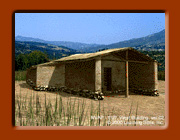
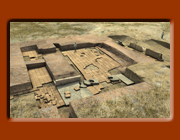
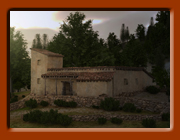
For example, digital modeling of Seyitomer, Turkey, based on photographs from the on-going rescue excavations to ensure that full site coverage is collected before removal of the evidence (above: photographs of the site and a Learning Sites rendering of a Hellenistic house using actual site photographs as wall textures).
|
|
|
|
| LEARNING
SITES
works with you to create archaeological analysis
tools that use advanced computer graphics and that are tailored to your specific needs, re-creating the original ancient context of objects and architecture.
Since the past happened in 3D, so should our study of it. How better to test theories about a site, a building, or an event, than by reproducing the locations as an interactive computer model so that you can see the past through the eyes of ancient inhabitants?
|
For example, choose a site or building and associated artifacts from your work. We'll reproduce them in a 3D computer model, re-placing the objects in an authentic, researched setting and will program the environment for virtual reality. You'll be able to approach and explore the site and its objects, move around them, and get a near firsthand experience of the place--begin to ask questions of the data, such as "how do the doorway locations affect how inhabitants moved through the spaces?" "how would different lighting methods or window placement affect activities in various spaces?" We will also link text and still images (or narrations) to objects in the virtual world, providing you and your colleagues with an interactive and exciting research and study experience.
|
|
|
|
| LEARNING
SITES
works with you to produce publications of your architectural or archaeological materials on DVD or the Internet, supplementing or supplanting traditional paper-based publications, for personalized interactive research. |
For example, an interactive 3D computer model can be a visual index to a publication, allowing users to walk through buildings or sites and select, with just a click, the artifact or architectural element about which they want additional information (such as inventory data, bibliography, drawings, your analyses, or field diary excerpts). Such a model, or a virtual world constructed from it, can also be used in the classroom, engaging students in an active learning experience.
|
For example:
|
Prehistoric Settlements
on Tsoungiza, Ancient Nemea, Greece, digital excavation report
|
|
|
|
Northwest Palace of Ashur-nasir-pal
II, Nimrud, Assyria, digital publication
|
|
|
| "I am particularly pleased with such virtual reconstructions, because I am able to visit a site and travel across it and see things that I could not see in one image before or even see easily and quickly if I were able to visit the [actual] site; and see spatial relationships the way the ancient Assyrians intended."
(the late Samuel Paley, 2006, about our Northwest Palace re-creations)
|
|
|
|
 |
|
|
| LEARNING
SITES
works with you to create dynamic teaching tools
based on your fieldwork or your research. |
For example, your excavation data or project research can be turned into course supplements or entire educational packages through the addition of interactive virtual worlds, animations, and high-resolution 2D visualizations that we create under your supervision. Our educational packages are first extensively field tested across the country, and then commercial products are generated from which you receive royalties. In partnership, we can produce classroom materials using the most up-to-date information for the benefit of public education.
|
|
|
|
| LEARNING
SITES
works to make the entire archaeological process
(data retrieval, study, and dissemination) more efficient and effective. |
Digitize excavated materials as they are extracted, send the information back to our model shop where we will turn around 3D visualizations of the site, building, or assemblages to send back to you in the field to aid in redirecting or interpreting your excavation strategies. The same information can be placed on the 'Net, if you wish, for instant feedback from colleagues, thus providing you with the most current evaluations and interpretations while you work. The same digital data can provide you with stunning visualizations for teaching, publication, conference talks, and donor presentations.
|
|
These are only a few of the possibilities afforded by a LEARNING
SITES
approach. None of these tools or procedures has to stand alone; one
application can be built to complement another's, providing an integrated
solution to data access and research.
Tell us your ideas about how digital technologies might benefit your work.
|
|